Provide solutions for green, safe, intelligent and efficient power grids

What Are You Looking For?

Provide solutions for green, safe, intelligent and efficient power grids


What Are the Benefits of Using SF6 Gas Density Sensors in High-Voltage Electrical Equipment?
Jul 22, 2026In modern power transmission and distribution infrastructure, sulfur hexafluoride (SF6) gas remains the industry standard medium for electrical insulation and arc quenching. Used extensively in High-Voltage (HV) and Medium-Voltage (MV) gas-insulated switchgear (GIS), circuit breakers, and transformers, SF6 delivers unmatched dielectric strength.
However, maintaining the precise density of SF6 gas inside enclosed compartments is vital. A minor drop in density compromises dielectric resistance, leading to potential catastrophic electrical flashovers, equipment damage, and unplanned grid outages.
This is where digital, real-time SF6 gas density sensors become a mandatory component of modern substation condition monitoring. Unlike traditional mechanical pointer gauges that require manual inspection, high-precision electronic gas density sensors provide continuous, automated telemetry.
Below, we examine the primary technical and operational benefits of installing advanced SF6 gas density sensors from Fosense in high-voltage asset management.
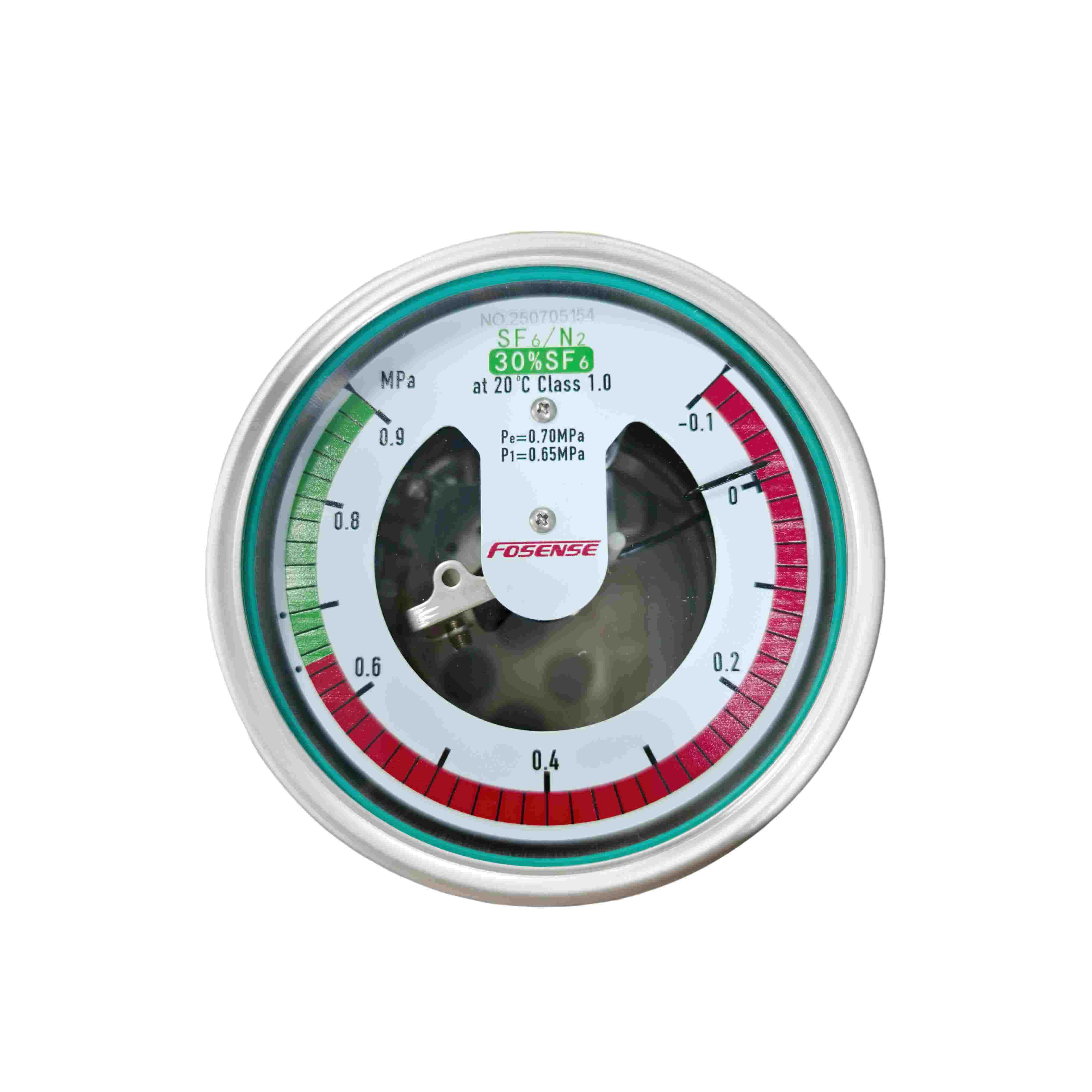
SF6 gas pressure fluctuates naturally with ambient temperature changes due to standard gas law physics. A simple pressure gauge cannot distinguish between a dangerous gas leak and a benign pressure drop caused by cold weather.
Gas density sensors solve this problem by incorporating digital temperature compensation algorithms. They measure pressure and temperature simultaneously to compute the normalized gas density at 20 degrees Celsius.
Micro-Leak Detection: Advanced Fosense SF6 gas density sensors feature high sensitivity (typically within ±0.5% to ±1% F.S. accuracy). They detect subtle micro-leakages at connection flanges, seals, or rupture discs long before pressure drops to critical threshold levels.
Proactive Maintenance Alerts: By outputting continuous digital data via RS485 Modbus or analog 4–20mA interfaces, these sensors trigger multi-stage alarms (such as Warning Level 1 for minor pressure drop, Lockout Level 2 for critical threshold). Maintenance teams receive automated alerts to schedule gas top-ups before an emergency trip occurs.
Safety is the paramount priority in high-voltage substations. When the density of SF6 gas falls below the manufacturer's specified threshold:
The insulation gap between phase conductors decreases.
The arc-quenching capability during circuit breaker operation diminishes rapidly.
Internal arcing, phase-to-ground faults, or explosive breaker failures can occur.
Integrating reliable Fosense gas density sensors into the substation automation system (SAS) provides an automatic safeguard. If density reaches a dangerous low point, the sensor signals the control system to lock out breaker operations (preventing opening or closing under fault conditions) or trip upstream breakers. This automated response protects human operators, prevents catastrophic equipment destruction, and mitigates fire risks.
High-voltage GIS installations represent a massive capital expenditure (CAPEX) designed for an operating lifecycle of 30 to 40 years. Continuous digital density monitoring directly preserves this capital investment:
Preventing Moisture Contamination: A loss of internal gas density often coincides with external moisture ingress. Tracking gas density stability protects internal contacts, solid insulators, and arc chutes from corrosive byproduct formation (such as HF and SOF2 generated when SF6 arcs in the presence of moisture).
Predictive Asset Management: Moving from time-based manual maintenance to condition-based maintenance (CBM) slashes operational expenditure (OPEX). Engineers monitor density trending curves over months or years, dispatching technicians only when data indicates a trend toward leak thresholds.
Sulfur hexafluoride is classified by the Intergovernmental Panel on Climate Change (IPCC) as one of the most potent greenhouse gases, with a Global Warming Potential (GWP) 23,500 times higher than CO2. Regulatory frameworks globally enforce strict reporting and containment mandates on power utilities.
Automated Environmental Auditing: Fosense SF6 gas density sensors provide continuous digital logging of gas retention across the entire substation fleet.
Zero-Emission Verification: Real-time monitoring allows utilities to quantify exact leakage rates annually, helping grid operators meet stringent local and international environmental reporting compliance without relying on manual gas mass balance calculations.
As the power sector transitions toward greener alternatives, many modern substations are adopting SF6 alternative gas mixtures, such as SF6/N2, SF6/CF4, or Fluoronox-based gas blends (C4-FN mixtures).
Non-SF6 gas mixtures exhibit different thermodynamic properties and pressure-temperature compressibility curves than pure SF6. Fosense engineers high-accuracy gas density sensors equipped with customized gas-mixture compensation formulas. This versatility allows power utilities to monitor both legacy SF6 assets and next-generation eco-friendly switchgear using a unified sensor hardware platform.
When selecting a digital gas density sensor for high-voltage assets, engineering teams must evaluate specific performance criteria:
| Parameter / Feature | Operational Requirement | Engineering Value |
| Temperature Compensation | Fully digital mathematical algorithm | Eliminates false alarms caused by extreme ambient temperature shifts |
| Signal Output | RS485 Modbus RTU / 4–20mA | Seamless integration into SCADA, IoT gateways, and online CBM platforms |
| EMC Immunity | Level 4 / High transient protection | Resists intense electromagnetic interference from switching operations |
| Ingress Protection | IP65 to IP67 stainless steel enclosure | Ensures outdoor durability in harsh climatic environments (-40°C to +80°C) |
| Process Connection | Custom thread / Self-sealing valves | Allows hot-swapping or installation without gas evacuation |
Fosense specializes in precision instrument design for electric power systems and industrial gas monitoring. Engineered specifically for high-voltage and medium-voltage applications, Fosense SF6 gas density sensors deliver the ruggedness, accuracy, and long-term stability required by leading switchgear original equipment manufacturers (OEMs) and grid operators worldwide.
High-Precision Digital Sensing: Combines ultra-stable pressure transmitters and low-drift temperature probes to deliver high accuracy over wide operating ranges.
Strong Electromagnetic Interference (EMI) Resistance: Fully shielded circuit architecture designed to operate reliably alongside high-voltage GIS busbars and heavy breaker switching.
Customizable Thread Connections & Interfaces: Flexible mechanical fittings (G1/2, M20x1.5, custom flange mounts) tailored to match global OEM equipment specs.
Seamless Smart Grid Integration: Digital Modbus communication enables real-time asset health analytics, automated alarms, and predictive maintenance modeling.
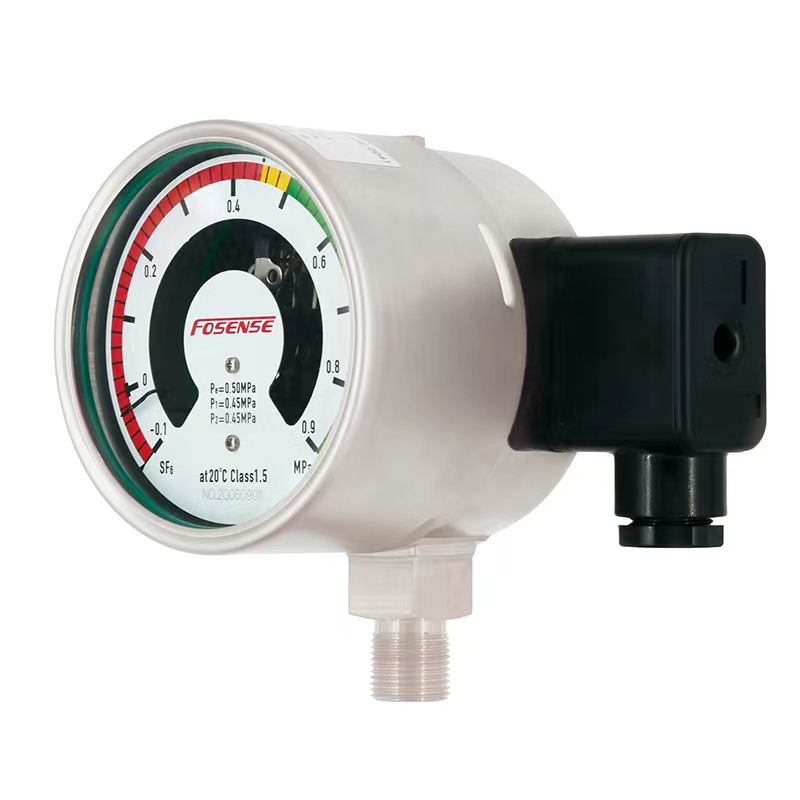
An SF6 pressure gauge only measures static pressure, which varies whenever ambient temperature changes. An SF6 gas density sensor measures both pressure and temperature to calculate the true gas mass per unit volume (density) normalized to 20°C, eliminating false readings caused by ambient weather changes.
Yes. When paired with self-sealing valves or sampling manifolds, Fosense gas density sensors can be installed, calibrated, or serviced without discharging the SF6 gas or interrupting the breaker's operation.
Fosense digital density sensors output standard RS485 Modbus RTU or 4–20mA signals. These protocols connect directly to substation remote terminal units (RTUs), edge gateways, or centralized SCADA software for continuous telemetry logging.
Safeguarding high-voltage assets requires reliable, continuous data. Installing high-performance SF6 gas density sensors eliminates manual inspection errors, prevents catastrophic equipment outages, minimizes environmental gas loss, and transitions your substation maintenance strategy into a proactive, data-driven framework.
Explore the complete lineup of Fosense gas density sensors and digital monitoring solutions at Fosense Instruments to upgrade your grid reliability today.



Friendly Links :
© 2026 Fosense Instrumentation Co.,Ltd .All Rights Reserved